10 Easy Tips to Teaching Drawing in Your Homeschool
Are you a homeschooling mom eager to ignite your child’s artistic flair but feeling a bit lost because you can’t draw yourself? Fear not! Teaching drawing doesn’t require Picasso-level skills; it’s all about fostering creativity and enjoying the process together.
Homeschooling is SUCH a journey. It is a huge undertaking, educating our children. It is hard enough to teach the subjects that we are good at; it can seem daunting to teach subjects that we have never learned ourselves.

There are many homeschool subjects that I have not mastered: learning to play an instrument, Latin, or drawing. I also realized my limitations in science, math, geography, etc.
As I progress through homeschooling education, I realize that I really had a horrible education- it was based on test scores and just getting through the school years.
It was never focused on the true, the good and the beautiful.
The encouraging news is that I can learn what my education was lacking alongside my children, and you can too. Drawing is just one of the subjects that can bring real beauty and joy to your kids and your homeschool.
Just like math, science and Latin, learning to draw just takes a little practice and perseverance.
You already have perseverance, since you are a mom. I believe you have extra perseverance, since you discerned to be a homeschool mom.
So, even if you have NO artistic ability, and you want to instruct your kids in drawing, here’s a friendly guide to help you embark on this artistic journey with your little ones.
Why Should You Be Teaching Drawing?
In a traditional classroom environment, worksheets abound. Coloring pages, fill in the blanks, multiple choice questions……these are the tools used to assess learning.
It’s different in our homeschools. We don’t need worksheets!
In home education, we are reading to our kids, or guiding them through a curriculum. Often, we ask for oral narrations, written summaries or hands-on projects to access learning- instead of tests.
Drawing can be a great part of the assessment process, from the early years all the way through high school.
Asking students to include a drawing of the lesson learned is a fantastic way to assess your children’s grasp of a concept, figure or idea.
Drawing Helps Learning Retention
In our early years of homeschooling, our children cannot write paragraphs or reports. Of course, we can buy workbooks or coloring pages to go along with our learning. But……worksheets are not required for homeschool.
For true learning, I think there are three steps:
- Absorb information: Watch, hear or read material to be learned.
- Process information: Respond through a worksheet, a narration, an illustration.
- Divulge information: Share what you learned with someone else.
Drawing can be a great way to process information, and it can help with sharing information with others.
For example, I read the story of David and Goliath to my daughters. They are 4 and 7 years old. I require a narration from both of them (my 4-year-old won’t be left behind!). Both girls draw a picture of the story and then tell me about it (a narration).
If I was asking my 9-year-old to do the same, I would also ask for a written summary and bible verse to help illustrate the story.
If you ask for illustrations regularly in their learning, they will learn to draw.
Embrace the Learning Adventure
Remember that teaching drawing is an adventure, not a destination. Embrace the learning process alongside your child, and don’t be afraid to make mistakes. Show them that it’s okay not to be perfect and that every stroke is a step towards improvement.
I will often draw alongside my children. It’s a fun thing to do together and they bolster my ego because they think I am a fabulous artist (I am NOT). Lead by example and show them it is okay to be imperfect.
Explore Online Resources
The internet is a treasure trove of tutorials and resources for budding artists. Platforms like YouTube offer a plethora of step-by-step drawing tutorials suitable for various skill levels.
My favorite online resource is Art Hub For Kids. It has so many tutorials and we use it for a lot of subjects: everything from nature study to Christmas pictures.
My four-year-old is obsessed with their Christmas snow globe tutorial. We have also drawn some fun historical figures, like this tutorial of George Washington.
Invest in Drawing Books
There are some lovely drawing books tailored for beginners. Look for titles that break down the drawing process into simple steps, providing clear instructions and encouraging creativity. These books often include exercises that gradually build your child’s confidence and skills.
I really like the following books to assist in drawing instruction.

Foster a Creative Environment
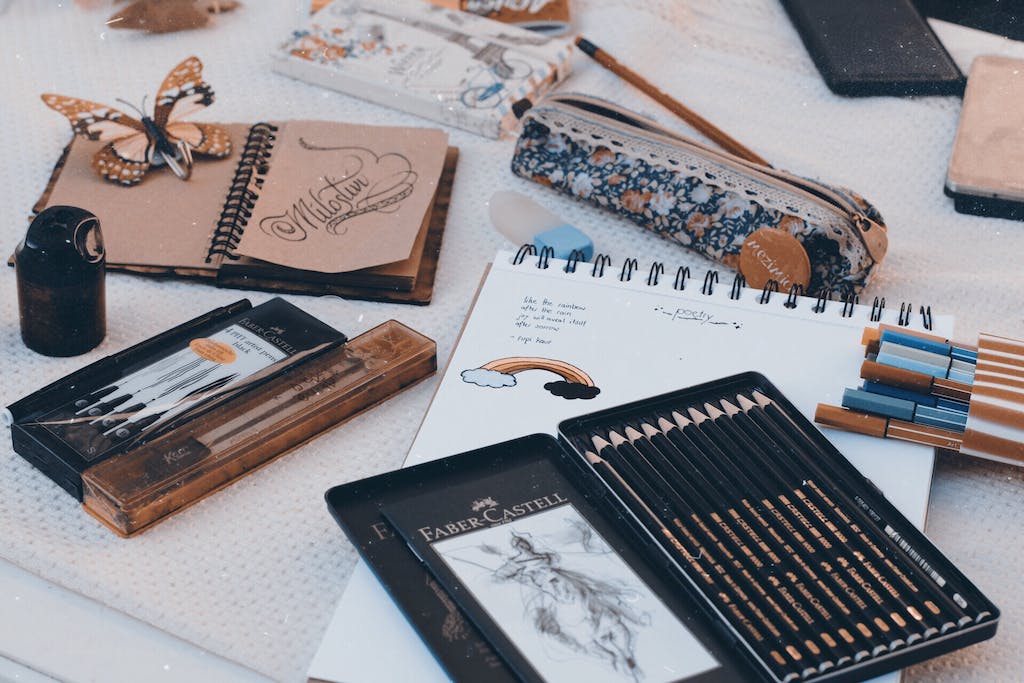
If you want your children to draw, provide them with items that make it fun! Pencils, drawing paper and fun drawing books are a great start.
I love these portfolio notebooks to keep a record of all my younger children’s illustrations and narrations in a school year. My older sons use these notebooks for sketching too.
Pay attention to the medium they prefer to draw in. One of my sons prefers to draw in pencil, but my daughter LOVES permanent markers.

Tracing is Okay
In Charlotte Mason and Montessori education, it is okay to start your drawing endeavors with tracing. My young children love tracing. It allows them to feel a lot of success early on.
Make tracing paper one of your go-to art supplies and encourage your kids to trace out of their favorite picture books. I promise they will love it!
Encourage Frequent Doodling
My mom was a doodler. when I was a child. I think it was because her phones had cords, and she would doodle while she talked. I always marveled at her “art,” and I think it is a really fun and healthy habit.
Doodling is an excellent way for your child to express themselves and develop their drawing skills organically. Provide sketchbooks or loose sheets of paper and encourage them to doodle whenever inspiration strikes. This unstructured approach allows for self-discovery and the development of a personal drawing style.
There are a lot of fun doodle books to journal your child’s way to becoming a proficient artist.


Work on a Nature Journal
Nature journals are great ways to work on your drawing skills. Requiring sketches of natural subjects adds to the beauty of the journal. I keep a nature journal alongside my children. We are learning and drawing together, and it is a lot of fun!
I have written a little about how our family does nature journaling in this post: September Nature Journaling.
Celebrate Progress, Not Perfection
Remind your child—and yourself—that the goal of drawing is not perfection but progress. Celebrate each small victory, whether it’s mastering a specific technique or completing a drawing independently.
Positive reinforcement builds confidence and makes the learning process enjoyable.
In conclusion, teaching drawing in your homeschool doesn’t require you to be a skilled artist. Embrace the journey, utilize online resources and books, create a nurturing environment, and celebrate the joy of creativity with your child. Together, you’ll embark on a colorful adventure that goes beyond the strokes on paper, fostering a lifelong love for artistic expression.

For more Homeschool Hobby teaching tips:
How to Teach Reading: The Best Homeschool Resources
Homeschool Planning: 4 Important Reasons to Start NOW
An Easy Large Family Homeschool Schedule: 10 Tips to a Great Day
Please share on Pinterest and follow our Homeschool Hobby Facebook Page!